
This Market Impact Report is for CIOs, chief AI officers, and enterprise transformation leaders seeking to understand how leading organizations embed AI into core strategy, operations, and culture to drive measurable business results.
The enterprise AI landscape is fracturing into a two-speed reality. While every organization is racing to adopt AI, our study reveals a startling truth: 88% are stuck in the slow lane, constrained by dangerous levels of accumulated enterprise “debts” that derail their digital ambitions. In contrast, a small but significant 12% have successfully cracked the code for enterprise-wide AI integration, creating a growing chasm between enterprises that have mastered AI and those still grappling with fundamental challenges.
To understand this divide and how to crack this enterprise AI code, HFS Research, in partnership with Infosys, surveyed 553 senior decision-makers from organizations worldwide with revenues ranging from $500 million to more than $50 billion, spanning 15 industries and 17 countries. The process also included in-depth interviews with enterprise AI leaders to understand where organizations are in their AI maturity journey.


The consequences of failing to manage these debts are severe. Organizations stuck in Phase 1 risk falling permanently behind as AI evolves from a competitive advantage to a survival necessity. Meanwhile, the 12% of firms in Phase 3 are driving faster revenue growth, stronger operational efficiency, and sustained market leadership.
As AI matures, today’s table stakes will become tomorrow’s liabilities. Enterprises must stop playing defense and start building an AI-first strategy—one that fuses technology with human ingenuity, breaks down data silos, scales AI deployments, and creates a digitally fluent workforce. Those who master these moves will be the Purposeful AI leaders of tomorrow.
The research provides valuable lessons from enterprises with mature AI initiatives that can help us achieve our AI goals.
While every industry boasts powerful AI use cases (see the appendix for prominent AI use cases by industry), few have successfully integrated AI purposefully into their organizations. Many firms remain stuck in experimentation mode, hindered by legacy processes, cultural resistance, and a lack of clear ROI. True AI integration requires more than technology adoption—it demands reimagining workflows, upskilling talent, and embedding AI into decision-making and operations.
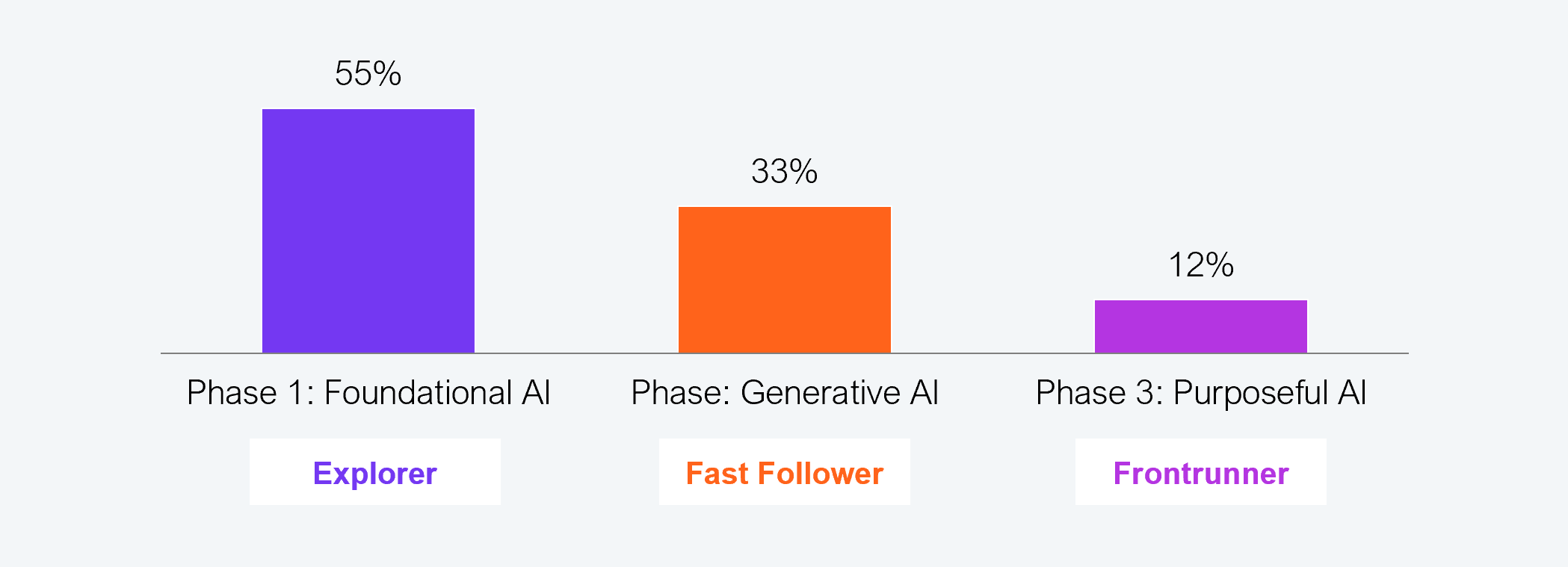
HFS defines AI maturity as progressing through three waves: Foundational AI, Generative AI, and Purposeful AI. Based on a comprehensive evaluation of eight key elements—strategy and leadership, deployment, technology, investments, governance and ethics, ecosystem, data, and people and culture—each wave represents a deeper integration of AI within an organization’s core operations and strategies (see Exhibit 1).
Sample: 553 executives across global 2000 enterprises
Source: HFS Research in partnership with Infosys, 2025
88% of enterprises are stuck in the basics—only 12% have strategically embedded AI to drive true transformation.
In the first wave, Foundational AI, where 55% of organizations currently operate, companies primarily use AI for basic tasks such as workflow automation, usually confined to IT departments. This stage involves classifying data and performing routine, rule-based tasks but often lacks widespread integration across the organization. These organizations grapple with challenges in deployment, talent readiness, and data management.
The second wave, Generative AI, sees AI beginning to scale beyond isolated use cases, supporting complex tasks such as real-time data analysis and process automation and expanding into broader business functions. With 33% of organizations in this phase, they increasingly involve business units in AI initiatives and enhance data practices. However, many still struggle to develop comprehensive talent strategies and governance frameworks for enterprise-wide AI adoption.
In the final wave, Purposeful AI, a small group of organizations (12%) has successfully embedded AI into core operations and decision-making. These organizations demonstrate advanced deployment, data integration, AI guardrails, and talent management capabilities while fostering cultures that embrace AI innovation with robust governance.
High-maturity organizations (in Phase 3: Purposeful AI) demonstrate a striking advantage in financial performance over their low-maturity counterparts. This difference is most pronounced in revenue growth, with high-maturity organizations achieving an average growth rate of 7%, compared to just 2% for low-maturity organizations. This means high-maturity organizations grow at an impressive 3.5 times the rate of their less mature peers, underscoring the transformative power of advanced capabilities and strategic investments.
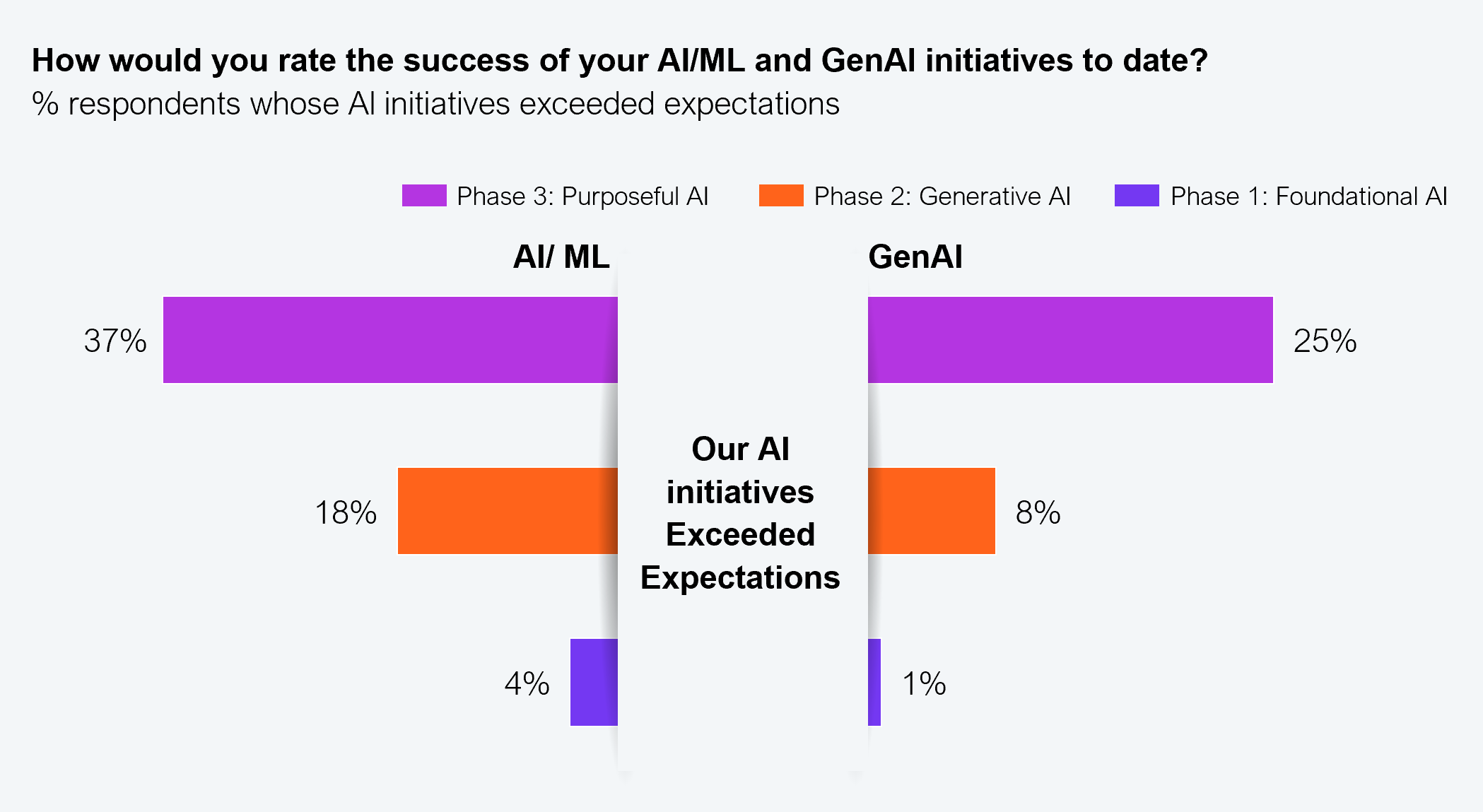
Our analysis also shows a strong correlation between AI maturity and tangible business impact. Phase 3 organizations are leading the pack, with 37% exceeding performance expectations through machine learning (AI/ML) and 25% doing the same with GenAI. In contrast, Phase 1 organizations struggle to move the needle, with less than 1% leveraging AI/ML and only 4% leveraging GenAI for measurable gains (see Exhibit 2).
Sample: 553 executives across global 2000 enterprises
Source: HFS Research in partnership with Infosys, 2025
An organization’s AI maturity directly influences its ability to innovate, optimize operations, and stay competitive. Companies with high AI maturity can automate complex tasks, make faster data-driven decisions, and deliver personalized experiences, all of which drive growth and efficiency.
What differentiates Frontrunner organizations in phase 3 is their ability to create a symbiotic relationship between AI technology and human expertise. These organizations have successfully integrated AI into their core business strategy, culture, and operations, treating it not as a separate initiative but as a fundamental aspect of doing business.
Companies in this phase have reshaped their entire operating model around AI, creating a new organization that seamlessly blends human and artificial intelligence to drive innovation and competitive advantage.
This holistic approach to AI integration distinguishes the leaders in the AI race from the followers, enabling them to realize the full potential of AI technologies across all aspects of their business.
AI is ultimately a business strategy enabled by emerging technology, but too many enterprises still place their technology solutions in the CIO’s organization to lead. As enterprises strive to unlock AI’s full potential, this divide between those who treat it as a strategic imperative and those stuck in fragmented, IT-driven approaches becomes increasingly evident. Mature enterprises are leading the way by embedding AI into their core leadership and decision-making frameworks.
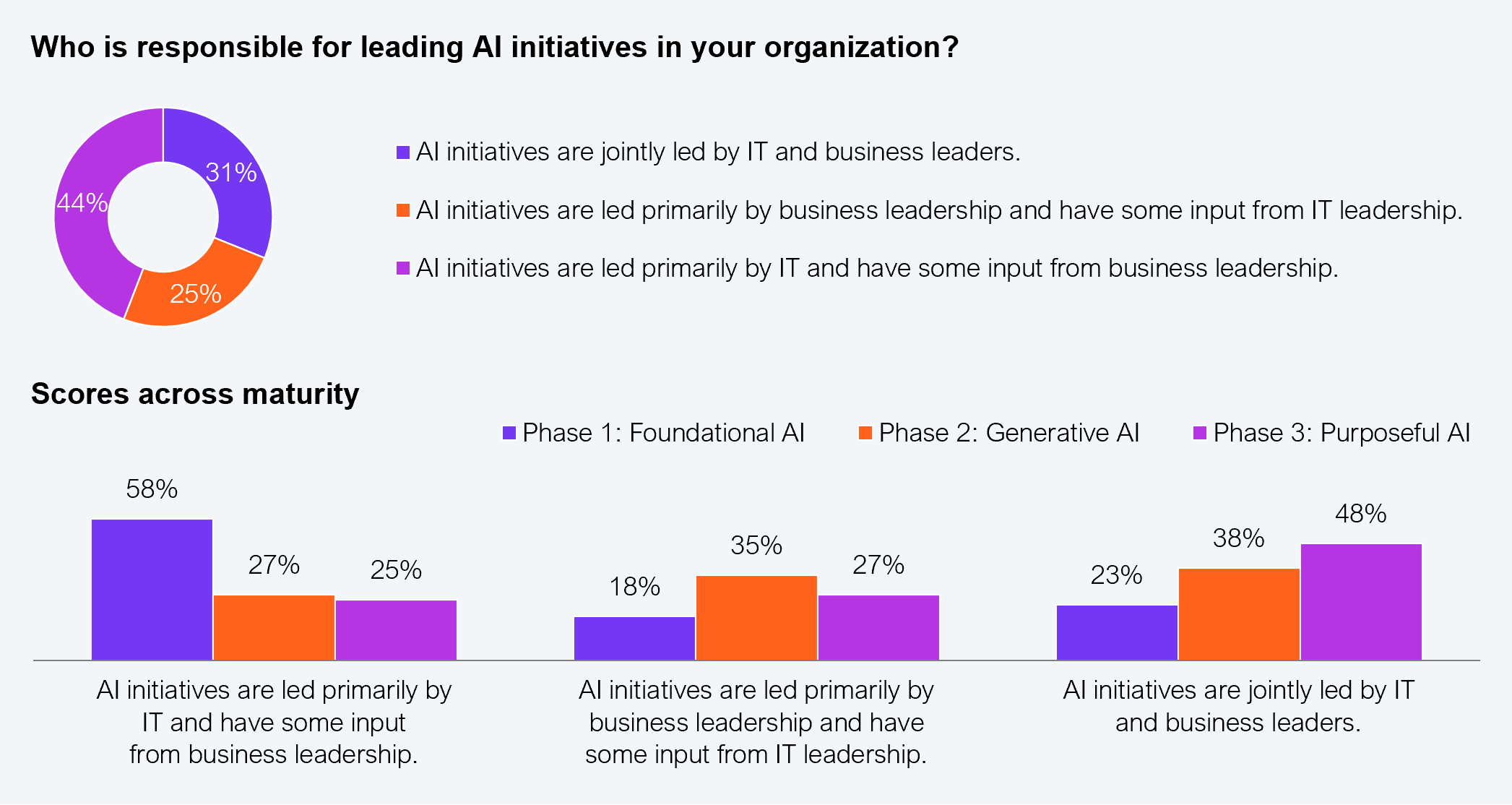
When AI ambitions exceed an organization’s ability to align leadership and strategy, it incurs “strategy debt,” a common challenge for most organizations, especially those in the earlier phases of maturity. These organizations often lead with IT-centric models, prioritizing technical implementation over cross-functional collaboration, which confines AI efforts to operational efficiency rather than driving strategic growth. This siloed approach leaves initiatives dependent on IT teams without broader executive buy-in, preventing scalability and limiting the ability to achieve enterprise-wide impact.
In contrast, Phase 3 (Purposeful AI) organizations bridge this gap by embedding AI leadership into their core strategy, creating joint IT-business structures, and driving transformative outcomes through strategic board mandates rather than short-term efficiency plays. While others remain trapped in siloed thinking, these organizations demonstrate true IT-business fusion, with 48% reporting joint leadership structures (see Exhibit 3).
Their AI initiatives are driven by strategic board mandates rather than mere efficiency plays, showing a sophisticated understanding of AI’s transformative potential that far exceeds cost-cutting.
Sample: 553 executives across global 2000 enterprises
Source: HFS Research in partnership with Infosys, 2025
Organizations are significantly expanding their GenAI investments, with an average year-over-year increase of 26%. However, a stark contrast emerges when comparing GenAI spending with traditional AI/ML investments. While organizations spend an average of ~$3M annually on GenAI initiatives, their AI/ML investments are nearly double, exceeding $6M annually, reflecting the more established nature of traditional AI programs.
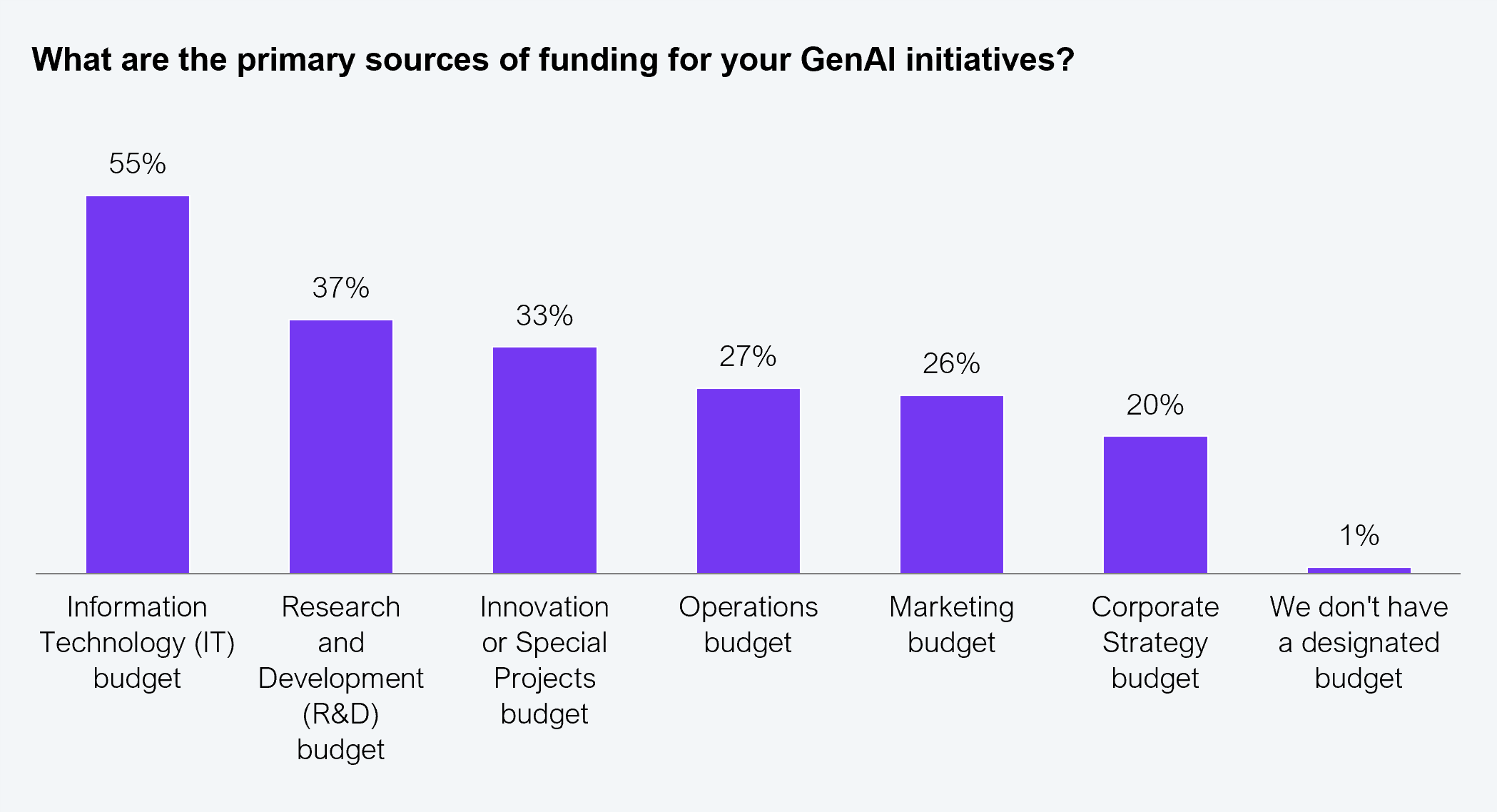
While organizations are pumping enterprise dollars into AI initiatives, the funding source is concerning—55% of GenAI investments come from IT budgets, suggesting many organizations still view AI primarily as a technology initiative rather than a business transformation tool (see Exhibit 4). Only 20% of organizations tap into corporate strategy budgets, highlighting a disconnect between AI investments and strategic business priorities.
Sample: 553 executives across global 2000 enterprises
Source: HFS Research in partnership with Infosys, 2025
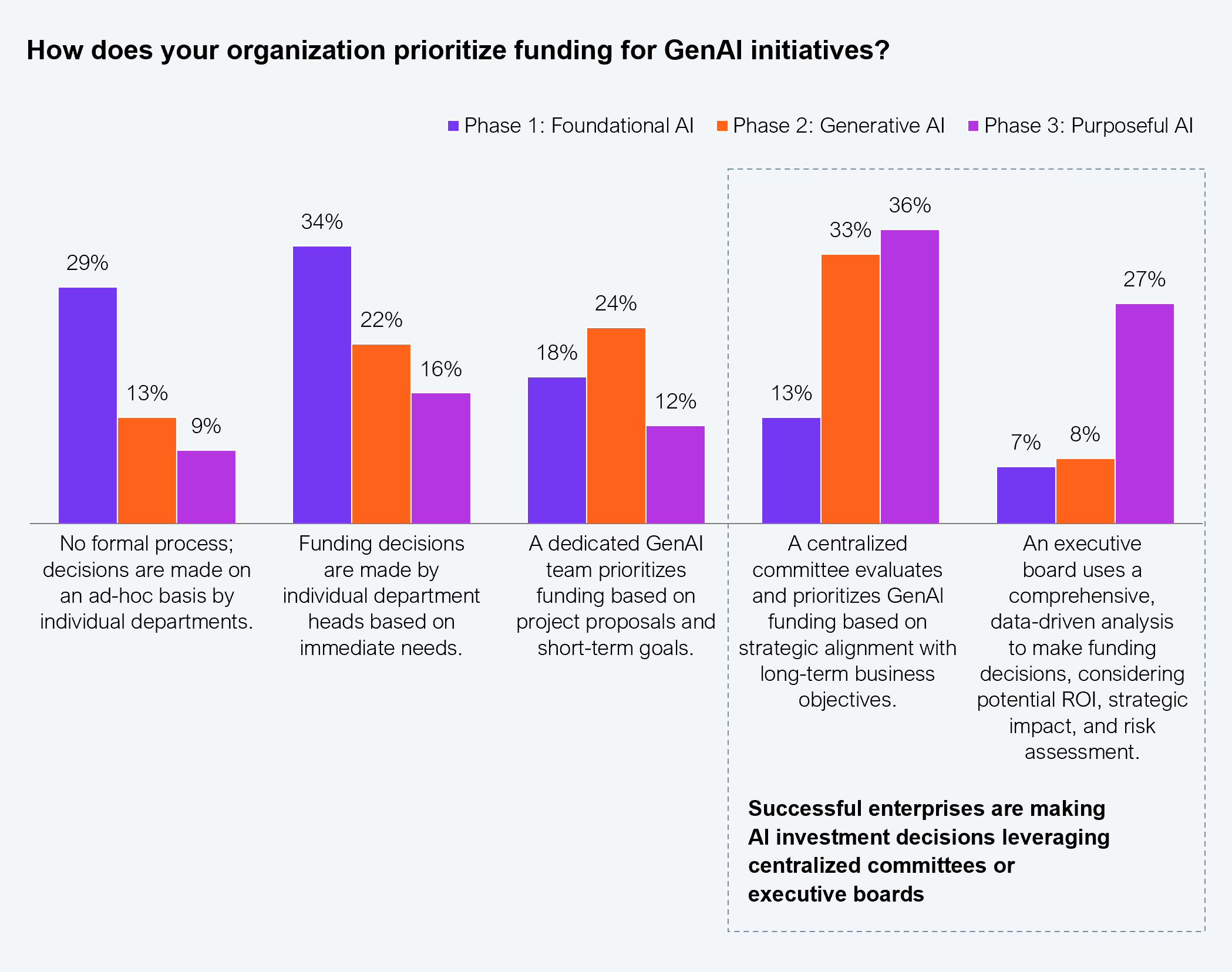
Most enterprises limit AI’s potential by relying on IT budgets rather than treating it as a strategic asset. While only 9% of organizations make AI investment decisions through executive board-level analysis, Phase 3 (Purposeful AI) enterprises stand apart—more than 60% manage AI investments through centralized committees using rigorous ROI analysis.
As one manufacturing CIO notes: “When you have a cross-functional AI board and senior leadership allocating a dedicated budget, you can drive real transformation. But if you just try to fund it from IT budgets, you’ll never realize the full strategic value.”
Sample: 553 executives across global 2000 enterprises
Source: HFS Research in partnership with Infosys, 2025
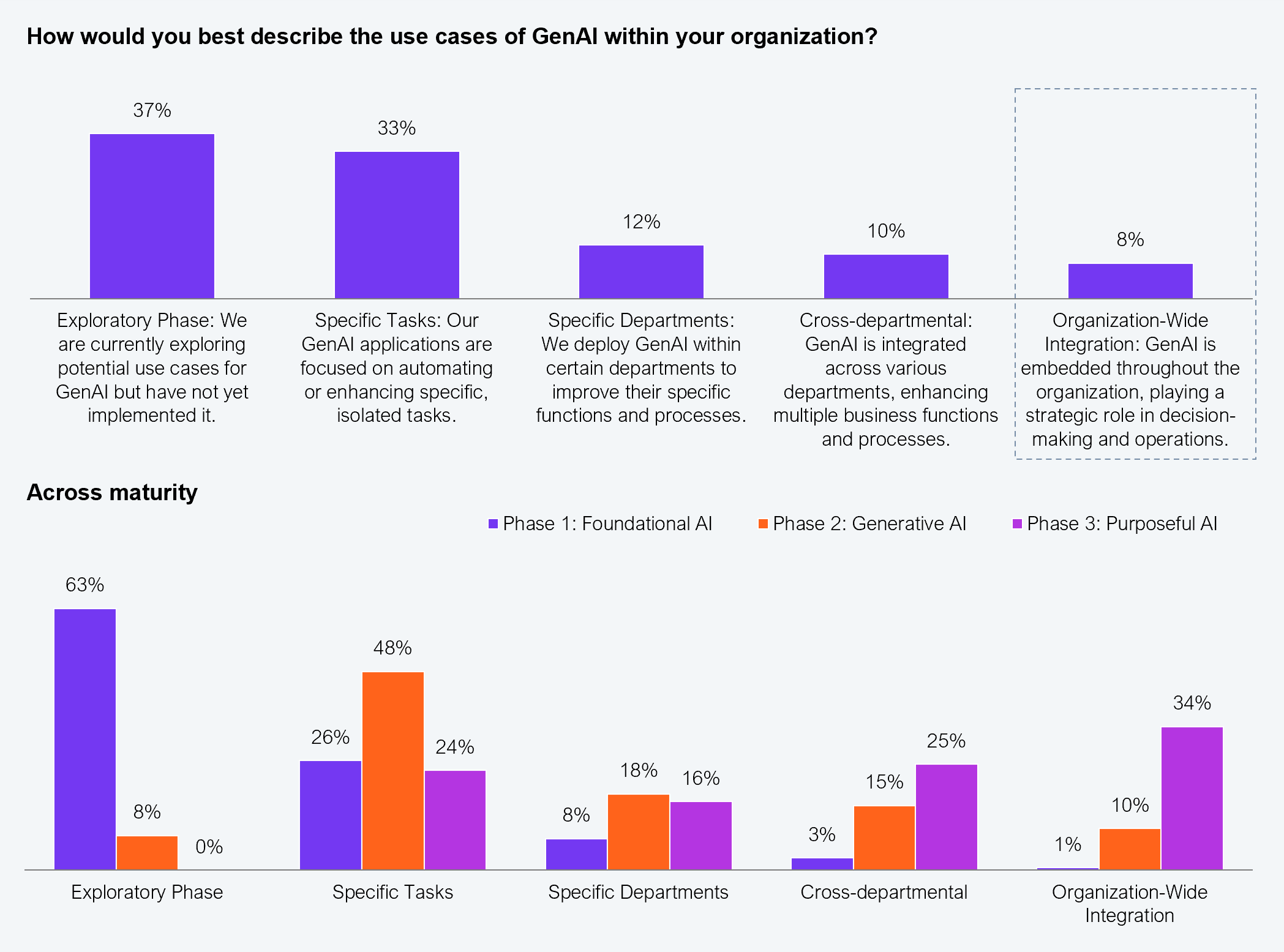
The promise of enterprise-wide AI deployment remains elusive for most organizations as they struggle to evolve from proven concepts to deploying actual processes and infrastructure. While business leaders rush to embrace GenAI’s potential, the reality of scaling beyond pilots presents a formidable challenge that few have mastered. While most organizations find themselves stuck in perpetual proofs-of-concept, Phase 3 enterprises achieve 34% enterprise-wide AI deployments, which is vastly different from those in Phase 1, which have only reached 1% (see Exhibit 6).
For the rest, this gap highlights the growing burden of process debt as organizations struggle to establish the frameworks and operational readiness needed to scale AI effectively.
Our research paints a sobering picture: 37% of organizations remain in the exploratory phase, while only 8% have achieved genuine organization-wide integration. The challenge runs deeper than surface-level deployment hurdles. Organizations that are still in the Foundational AI phase are particularly affected, with 63% remaining in exploratory stages with minimal frameworks for scaling.
Sample: 553 executives across global 2000 enterprises
Source: HFS Research in partnership with Infosys, 2025
As one CTO of a Fortune 500 manufacturing company notes:
“You can run small pilots and validate thousands of outputs manually. But scaling to millions of outputs requires automated validation and robust frameworks. Most companies focus on technology but miss this operational foundation—that’s where they get stuck.”
This crystallizes the core challenge: while organizations can run controlled pilots, they lack the automated validation, standardized governance, and operational processes needed for industrial-scale deployment. Companies find launching new experiments easier than building comprehensive frameworks for enterprise integration, creating compounding “process debt” as pilots multiply without addressing foundational scaling requirements.
Data is the lifeblood of AI transformation, yet most organizations are caught between the imperative to innovate and the instinct to protect. This cautious approach to data integration places an artificial ceiling on AI’s potential and exacerbates data debt.
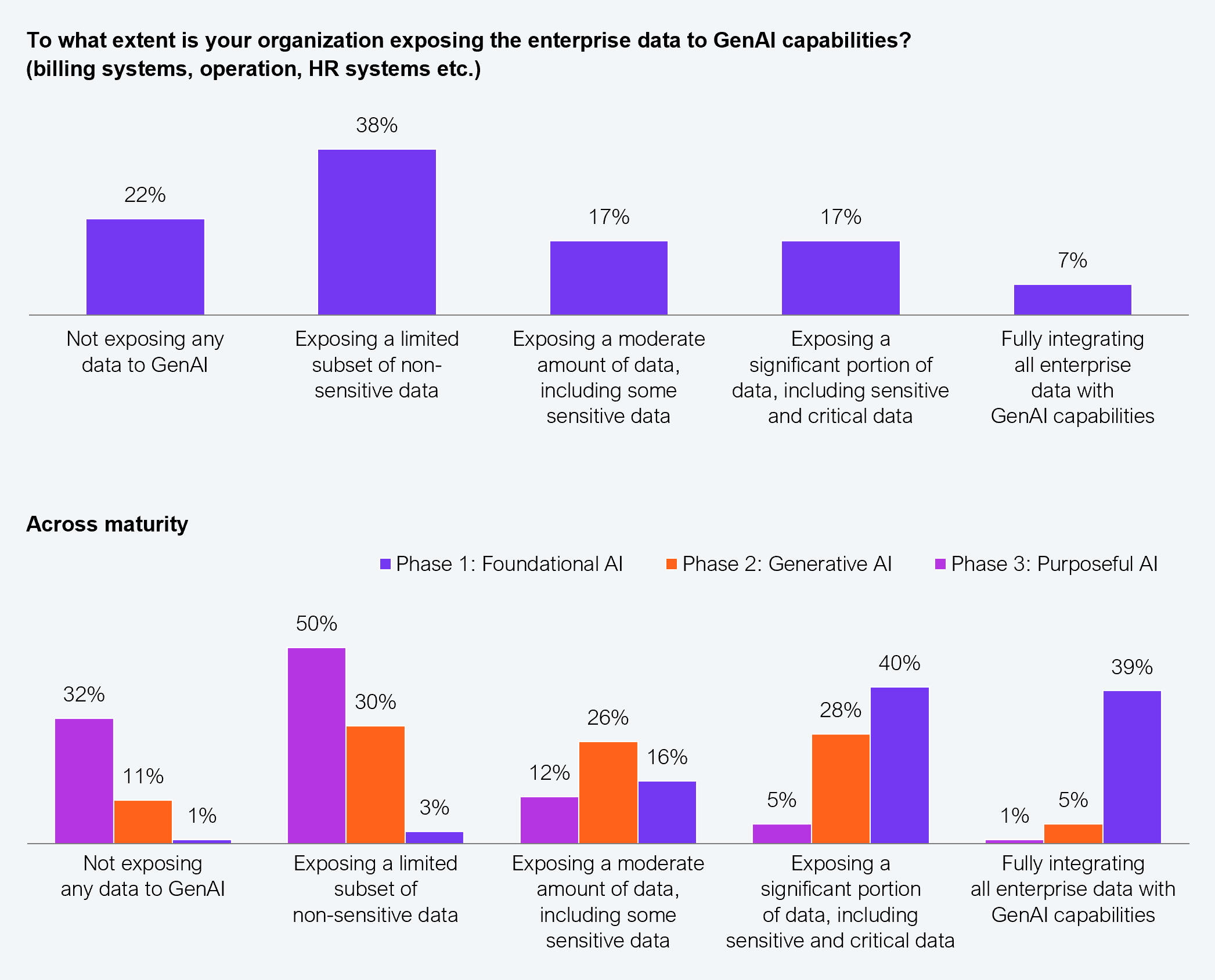
However, Phase 3 enterprises weaponize their data advantage—39% fully integrate enterprise data with AI capabilities while enabling 64% cross-departmental access. Rather than cautiously limiting data exposure like most organizations, they implement comprehensive governance frameworks that enable the safe utilization of sensitive data, turning their full data estate into a strategic asset.
Only 7% of organizations have fully integrated enterprise data with GenAI capabilities, while 38% take a highly cautious approach, exposing only limited, non-sensitive data. This extreme caution stems from deep-rooted data protection obligations, as the security leader of a global professional services firm reflected:
“From the moment data comes into our system, we are responsible for it at all times. When we first started, we were working with third-party providers… but I couldn’t tell you how those systems’ data was being protected. With our clients, we have contractual obligations that say we will not sell, share, give away, or reveal any of their sensitive information.”
This protective mindset artificially constrains AI’s potential. Many organizations are essentially trying to build sophisticated AI capabilities while keeping their most valuable data locked away, installing a self-imposed ceiling on what their AI initiatives can achieve.
Organizations in the Purposeful AI phase demonstrate a dramatically different approach to data integration. Our research shows that 39% of these mature organizations fully integrate all enterprise data with GenAI capabilities, compared to just 1% in the Foundational phase (see Exhibit 7). These leaders have overcome data privacy concerns through robust governance frameworks, enabling them to leverage sensitive data safely and effectively for AI initiatives.
Sample: 553 executives across global 2000 enterprises
Source: HFS Research in partnership with Infosys, 2025
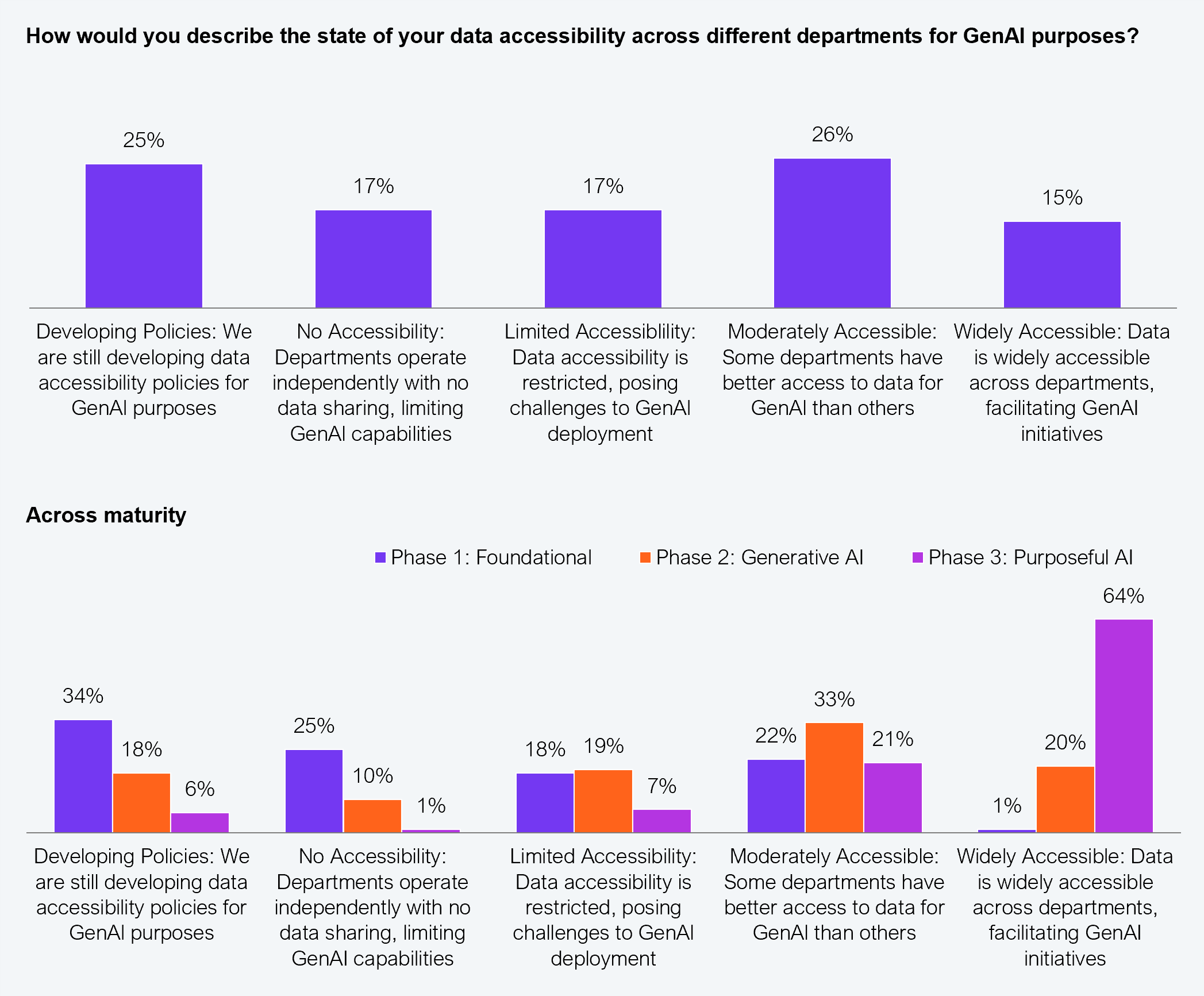
On average, only 15% have achieved wide data accessibility across departments for AI purposes, while 34% report limited to no accessibility at all. A quarter of organizations are still developing their data accessibility policies, suggesting widespread recognition of the problem but slow progress in addressing it. This fragmentation creates digital barriers between departments that prevent AI from delivering enterprise-wide value.
Mature organizations have solved this challenge through systematic data sharing and integration approaches. Among Purposeful AI organizations, 64% report wide data accessibility across departments, enabling comprehensive AI implementations (see Exhibit 8). These organizations have moved beyond departmental data ownership to create enterprise-wide data assets. They’ve achieved this through clear governance frameworks, standardized data-sharing protocols, and technology platforms that enable secure data access across the organization.
Sample: 553 executives across global 2000 enterprises
Source: HFS Research in partnership with Infosys, 2025
While most organizations struggle with accessing and exposing their data to AI, Purposeful AI enterprises are weaponizing their enterprise data, unleashing full data integration and cross-departmental access to power their AI initiatives. 39% of mature organizations fully integrate all enterprise data with GenAI capabilities, while 64% report wide data accessibility across departments. They’ve also cracked the code on data variety, with 43% maintaining a balanced mix of structured and unstructured data. This comprehensive approach to data integration enables them to tackle more sophisticated use cases and derive deeper insights that drive competitive advantage.
As AI capabilities grow more sophisticated, the gap between technical implementation and ethical governance widens. Organizations face mounting pressure to balance innovation with responsible AI deployment, yet most lack the frameworks to do so effectively. The result is a widening governance debt that is a ticking time bomb waiting to go off.
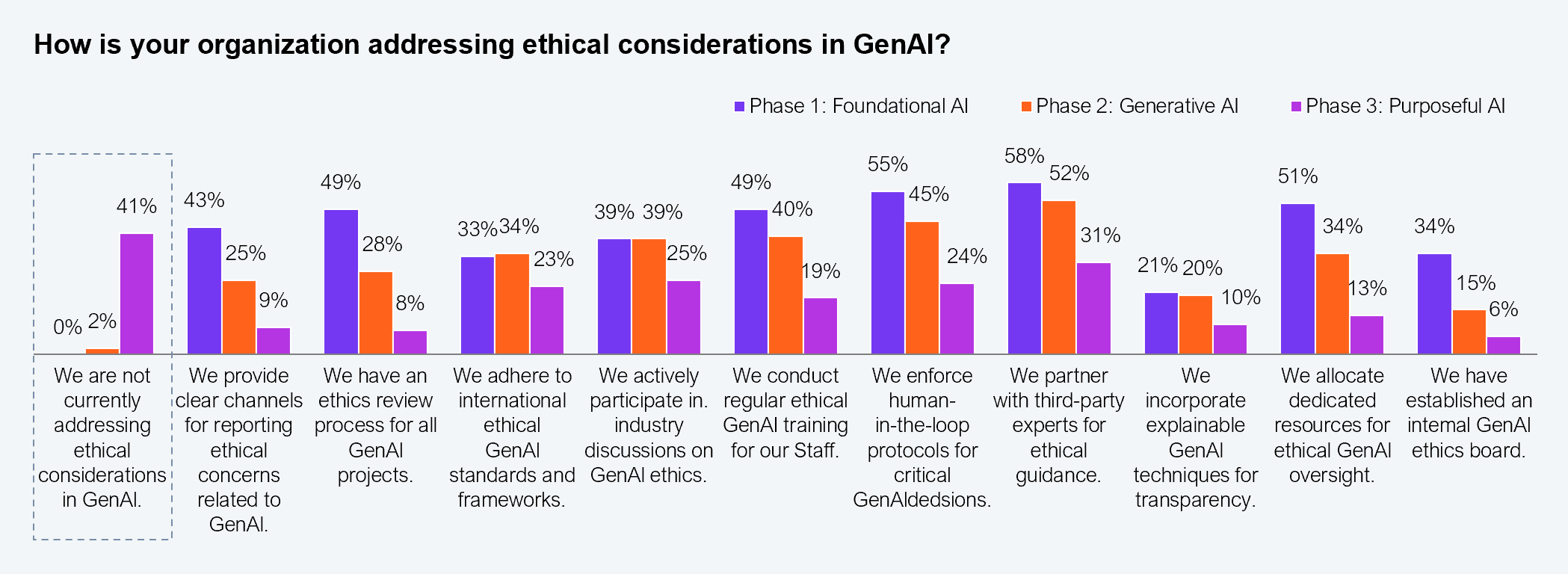
Phase 3 organizations implement sophisticated governance models, including building ethics boards, providing regular employee training, and creating clear pathways for reporting ethical concerns about GenAI projects. Unlike the majority, which are stuck defining basic frameworks, these leaders have established clear protocols for ethical AI deployment, data protection, and cross-functional scaling.
While there is widespread recognition of ethical concerns related to AI, as evidenced by, on average, 41% of respondents partnering with third-party experts and 35% implementing human-in-the-loop protocols, there is a notable lack of comprehensive, internal ethical frameworks (see Exhibit 9).
Phase 3 organizations are more likely to provide clear channels for reporting ethical concerns related to GenAI (43% compared to 9% of Foundational levels), as well as more likely to have an ethics review process for GenAI projects (49% compared to 8% in Foundational levels. They are also more likely to allocate dedicated resources for ethical guidance and establish internal GenAI ethics boards.
Sample: 553 executives across global 2000 enterprises
Source: HFS Research in partnership with Infosys, 2025
Data governance also remains a critical weakness. Only 28% of organizations still define their data governance frameworks for GenAI, and 10% operate without any enterprise-wide framework. This governance deficit creates compound risks as organizations attempt to scale their AI initiatives. Only 14% have implemented centralized data governance offices to support cross-functional teams and facilitate GenAI integration.
The impact of weak governance extends beyond regulatory compliance. Organizations lacking robust governance frameworks struggle to balance data accessibility with security requirements, creating a trust deficit that limits AI adoption.
The human element remains AI transformation’s most critical—and challenging—aspect. As organizations race to implement new capabilities, their workforce readiness and cultural adaptation lag behind dangerously.
Phase 3 enterprises drive cultural transformation by embedding AI capabilities across every business function. Rather than treating AI as a technical initiative, they invest heavily in workforce development, change management, and establishing clear frameworks for AI adoption—turning potential resistance into enthusiasm for AI-driven innovation.
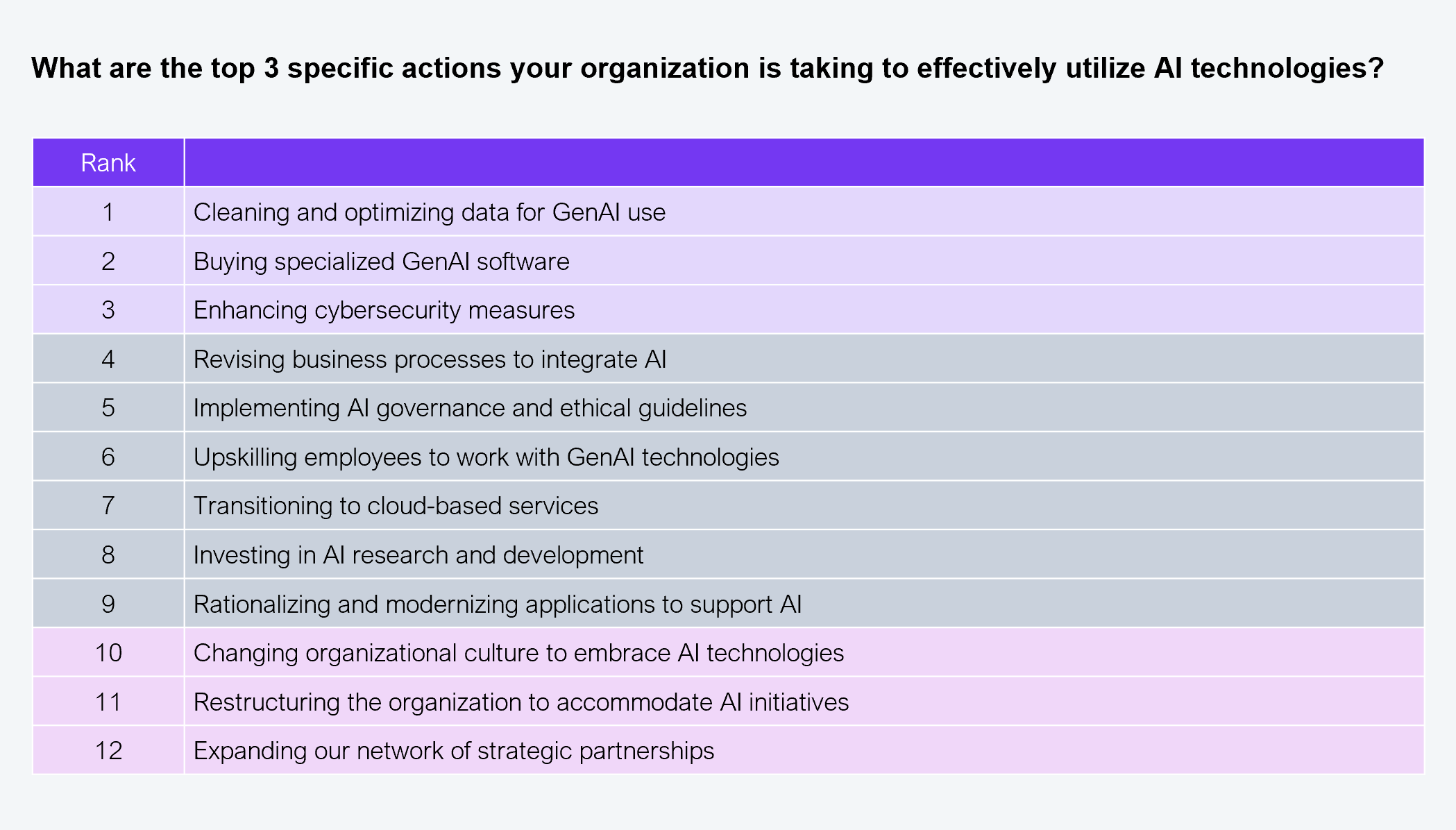
The impact of this cultural resistance extends beyond mere adoption challenges. Organizations are notably underinvesting in cultural transformation, with “changing organizational culture” ranking near the bottom of priority lists, while technical aspects such as data cleaning and software acquisition dominate. This misalignment between technical investment and cultural readiness creates a compounding debt that becomes increasingly costly as organizations attempt to scale their AI initiatives (see Exhibit 10).
Sample: 553 executives across global 2000 enterprises
Source: HFS Research in partnership with Infosys, 2025
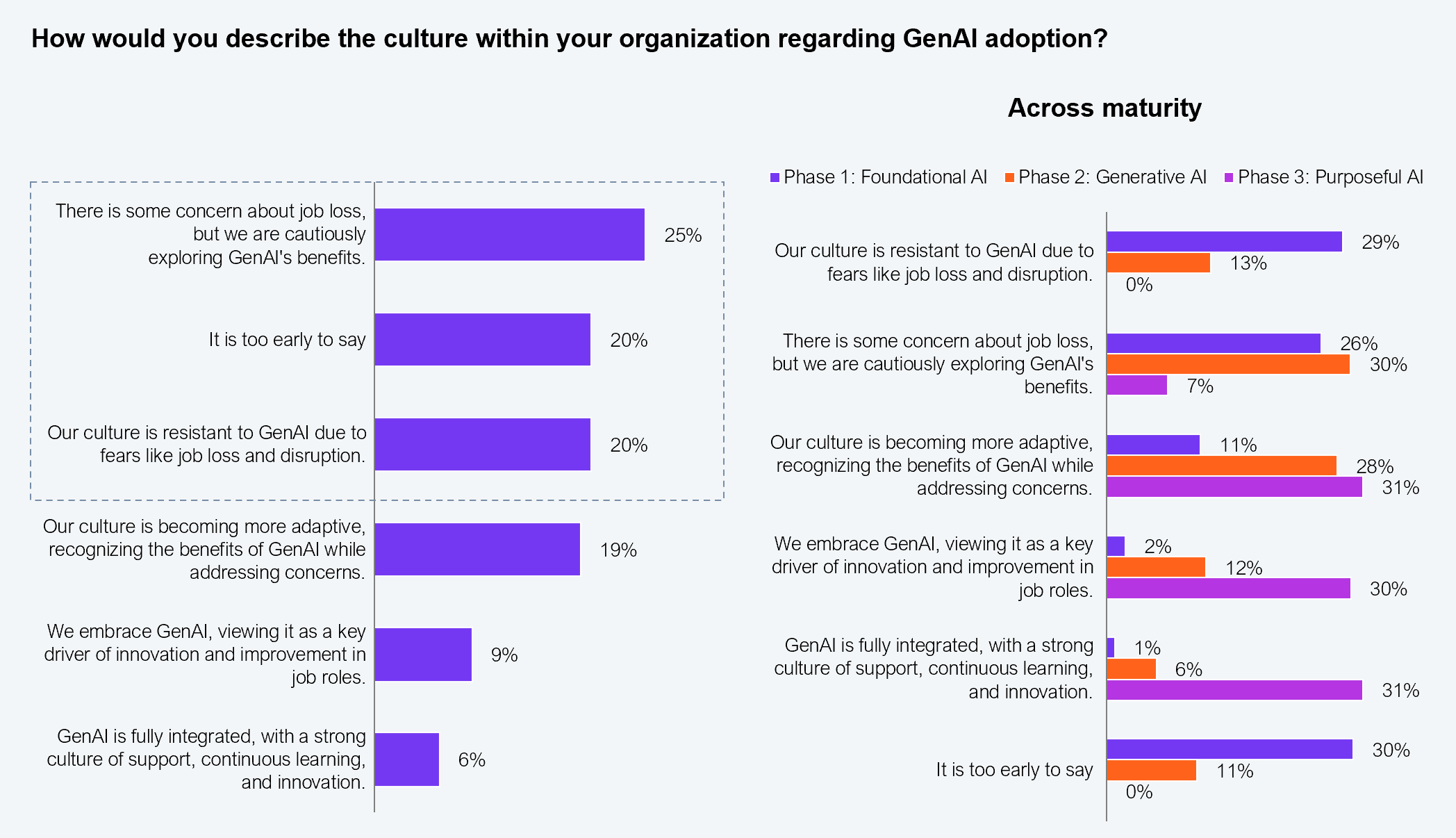
A startling talent crisis overhangs AI transformation efforts. While enterprises rush to implement AI capabilities, 65% of employees remain worried about job loss, resistant to change, or uncertain about GenAI adoption. Only 15% demonstrate genuine positivity toward AI initiatives, creating a significant people debt that undermines implementation efforts.
Resistance peaks in organizations at the Foundational AI phase, where 29% report explicit resistance due to fears of job loss and disruption. This cultural roadblock creates a compound effect: As organizations invest more heavily in AI technology, they face increasing resistance from the workforce needed to make these investments successful.
Phase 3 Purposeful AI enterprises recognize that AI isn’t just a technology shift—it’s a cultural one
(see Exhibit 11). They are investing in transforming their workforce into digital champions, embedding AI capabilities into daily operations across every business function.
Sample: 553 executives across global 2000 enterprises
Source: HFS Research in partnership with Infosys, 2025
A product leader at a global technology company highlights this challenge:
“We have two similarly skilled engineers who are very good at their job—one decided to embrace AI tools, the other didn’t. You see a 2x, 3x, 5x step change in productivity from the ones that do… But there’s no guidance. You have to be a complete self-starter versus having a cookbook and formalized guidance. That disparity is alarming.”
This underscores the critical need for structured cultural transformation to unlock AI’s full potential.
AI isn’t an aspiration—it’s here, working and advancing at an incredible pace. The real question is: Are we ready to keep up?
The gap between AI leaders and laggards is set to explode in 2025. While 12% of organizations push ahead with robust foundations and integrated AI capabilities, the remaining 88% risk getting trapped in a vicious cycle of compounding organizational debts that become increasingly expensive to address.
Even organizations in higher maturity phases can’t rest easy. As AI technology evolves exponentially, today’s maturity becomes tomorrow’s table stakes. Those trapped in cycles of paying off strategy, process, data, and talent debts will perpetually play catch-up.
To avoid permanent relegation to the digital slow lane, organizations must:









The consequences of carrying organizational debt will become severe as we enter the next phase of AI maturity, characterized by increasingly sophisticated technology and higher stakes for digital transformation. Those who fail to systematically address their strategic misalignments, process fragmentation, data silos, and talent gaps will find themselves unable to harness AI’s evolving potential.
Register now for immediate access of HFS' research, data and forward looking trends.
Get Started


If you don't have an account, Register here |
With the exception of our Horizons reports, most of our research is available for free on our website. Sign up for a free account and start realizing the power of insights now.
Our premium subscription gives enterprise clients access to our complete library of proprietary research, direct access to our industry analysts, and other benefits.
Contact us at [email protected] for more information on premium access.

